
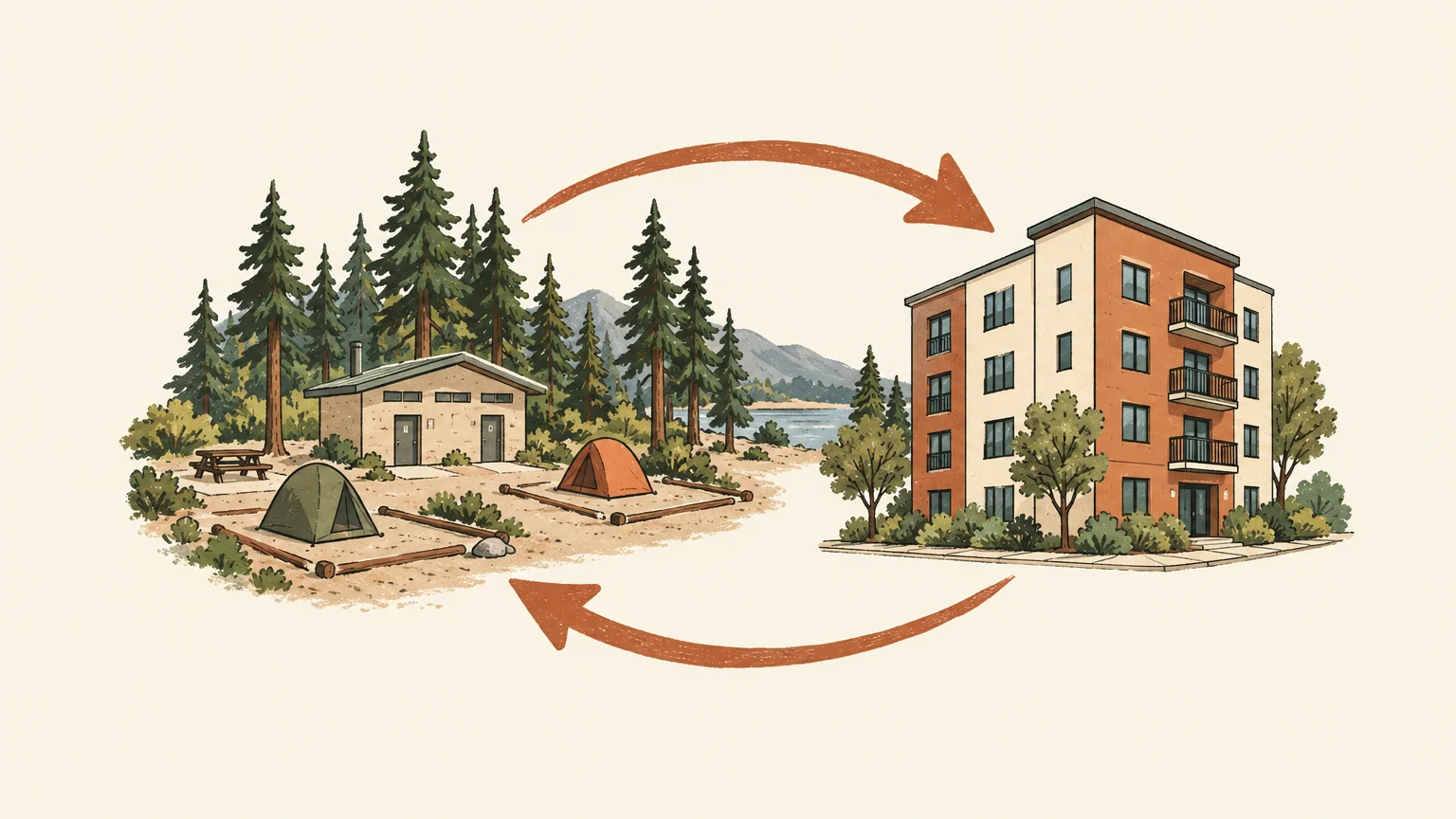
Selling a park you have run for fifteen or twenty years can push a large share of its appreciation into one tax year. The federal government taxes the long-term gain and applies a higher ceiling to the depreciation you took on the bathhouse and park infrastructure, including roads and utility lines. It may also add a surtax on investment income. California then taxes the same gain again as ordinary income, because the state has no reduced capital gains rate. A like-kind exchange under IRC Section 1031 defers both bills when you move the real estate proceeds into other investment real estate. The 1031 exchange rules California applies are the federal rules plus withholding at escrow and an annual information return if the replacement property is outside the state. California also keeps a claim on the deferred gain wherever that replacement property sits.
California 1031 exchange rules at a glance
California follows IRC Section 1031 for real property and layers on its own reporting and withholding requirements. For taxable years beginning on or after January 1, 2025, the state conforms to the Internal Revenue Code as of January 1, 2025 and limits like-kind exchanges to real property, matching the federal rule (FTB). The rules below are the ones that decide whether your exchange works and what California expects from you afterward.
- Qualifying property: Real property held for productive use in a trade or business or for investment, exchanged for like-kind real property that you will also hold for business or investment. Property held primarily for sale does not qualify.
- Qualified intermediary: A QI holds the sale proceeds between the two closings so that you never have actual or constructive receipt of the money.
- Two deadlines: Identify replacement property in writing within 45 days of transferring the relinquished property, and receive it within 180 days or by your return due date, whichever comes first.
- Boot: Cash or non-like-kind property you receive is taxable in the year of the exchange, up to the gain realized. Net debt relief also counts as boot.
- Form 593 withholding: The buyer or QI must withhold 3 1/3% of the sales price of California real property unless you certify the Section 1031 exemption on the form. An escrow holder may perform the withholding on the buyer's behalf.
- Form 3840 reporting: If the replacement property is outside California, you file Form FTB 3840 for the exchange year and every year after until the deferred California-source gain is recognized.
- State tax rate: California taxes all capital gains as ordinary income, so the deferred state gain eventually faces the regular bracket rates.
- QI protections: California's exchange facilitator statute requires a $1,000,000 fidelity bond (or equivalent deposits or qualified escrow) and $250,000 of errors and omissions coverage.
Federal rules California follows
You must exchange business or investment real property and keep the proceeds out of your control. The subsections explain the two property transfers and gain and depreciation deferral. They also cover the concurrent 45-day identification and 180-day receipt deadlines.
Section 1031(a)(1) sets the baseline: "No gain or loss shall be recognized on the exchange of real property held for productive use in a trade or business or for investment if such real property is exchanged solely for real property of like kind which is to be held either for productive use in a trade or business or for investment" (IRC §1031). The real-property-only limit came from the 2017 Tax Cuts and Jobs Act and applies to exchanges completed after December 31, 2017. The IRS Form 8824 page listed "Recent Developments: None at this time" as of August 27, 2026. A Senate bill, S. 4122, introduced March 17, 2026, would narrow the exclusion for exchanges after December 31, 2026, but the research located no enactment. The operating rules for a delayed exchange sit in Treasury Regulation §1.1031(k)-1, and the pieces below come from that regulation.
Relinquished vs. replacement property
The relinquished property is the one you transfer; the replacement property is the one you receive. In a campground sale, the relinquished property is the land and permanent improvements you are selling, and the replacement property is whatever investment real estate you buy with the proceeds. Both legs must be real property held for business or investment. The regulation defines real property as "land and improvements to land, unsevered natural products of land, and water and air space superjacent to land" (Reg. §1.1031(a)-3). Any real property is like-kind to any other real property, so a park can be exchanged for an apartment building, farmland, a self-storage facility or another park.
A deferred exchange is one where you transfer the relinquished property "pursuant to an agreement" and later receive the replacement. If you do not satisfy the identification and receipt rules, or fail to meet the intermediary requirements, the IRS treats the replacement "as property which is not of a like kind to the relinquished property" (Reg. §1.1031(k)-1). When you sell more than one property into a single exchange, both clocks start on the earliest transfer date.
Capital gains and depreciation deferral
A valid exchange postpones tax on the gain; it does not erase it. The IRS fact sheet on like-kind exchanges puts it plainly: deferred gain "is tax-deferred, but it is not tax-free" (IRS FS-2008-18). Under §1031(d), your basis in the replacement property equals your basis in the property you gave up, decreased by money received and increased by gain recognized. The appreciation you have built in the park since you bought it carries forward into the new property and comes due when you sell that property for cash.
Depreciation recapture defers the same way, with a limit. If no gain is recognized under §1031, the ordinary recapture amount under §1250(a) cannot exceed the greater of the gain recognized or the excess of the gain over the fair market value of the §1250 property you acquired (IRC §1250). The untaxed depreciation carries over to the replacement property under §1250(d)(4)(E).
Components classed as §1245 property for depreciation, which can include items a cost segregation study assigned to five- and seven-year lives, trigger ordinary income if you trade down into a replacement with less of that property. The Tax Adviser's example: $80,000 of fully depreciated five-year components produces no recapture if the replacement contains at least $80,000 of five-year components (Tax Adviser).
For a California park that has been depreciated for two decades, the state's treatment adds a wrinkle. California does not conform to federal bonus depreciation, and its §179 limit is $25,000, so your California adjusted basis in the park can differ from your federal basis (FTB Form 3885A instructions). The state's Schedule D-1 instructions require you to report a like-kind exchange even if no gain is recognized, and to make a California adjustment where federal Form 4797 recapture differs (FTB).
The 45-day and 180-day deadlines
Both clocks start the day you transfer the relinquished property, and they run at the same time. The identification period "ends at midnight on the 45th day thereafter." The exchange period ends "at midnight on the earlier of the 180th day thereafter or the due date (including extensions) for the taxpayer's return" for the year of the transfer (Reg. §1.1031(k)-1(b)(2)). The return due date trap matters for late-year closings. A Journal of Accountancy article on like-kind exchanges notes that a taxpayer whose exchange is not complete by the return due date must file for an extension to keep the full 180 days; otherwise the period ends on the due date, "thereby triggering gain recognition" (Journal of Accountancy). Breakwater, a qualified intermediary, calculates that for a 2026 sale any closing after October 17, 2026 is affected and that a Form 4868 extension restores the days. That cutoff comes from a practitioner, not the IRS.
If you miss either deadline, the IRS treats the exchange as a sale. Under the regulation, if you receive money directly or constructively or non-qualifying property for the full consideration, "the transaction will constitute a sale, and not a deferred exchange." The IRS fact sheet is blunter: "you must meet two time limits or the entire gain will be taxable." The IRS cannot help after the fact. Chief Counsel correspondence dated November 24, 2025 states that "the 180-day deadline to acquire replacement property is set by statute" and that the IRS "does not have the authority to extend the 180-day replacement period" apart from specified disaster-related events (IRS Chief Counsel).
Disaster relief is the one exception. Rev. Proc. 2018-58 postpones a 45-day or 180-day deadline that falls on or after a federally declared disaster date "by 120 days or to the last day of the general disaster extension period ... whichever is later," subject to the return due date and a one-year cap, and only when an IRS news release provides it (Rev. Proc. 2018-58). After the January 2025 Los Angeles wildfires, eligible taxpayers could extend the 45-day period to October 15, 2025 (Holland & Knight). One point the retrieved authority does not settle is what happens when day 45 or day 180 lands on a weekend or holiday. IPX1031, another QI, says the periods "cannot be extended even if the 45th day or 180th day falls on a Saturday, Sunday or legal holiday." No IRS source either confirms or rejects that reading, so the safe course is to treat the calendar day as final.
Identification rules: 3-property, 200% and 95%
You may identify replacement property under any one of three alternative limits, and all three live in Reg. §1.1031(k)-1(c)(4). The identification itself must be in a written document you sign and deliver before the 45-day period ends, either to the person obligated to transfer the replacement property to you or to another party involved in the exchange who is not you or a disqualified person. You may send the document to an intermediary or an escrow agent. A title company is another example in the regulation. Real property must be described unambiguously by "a legal description, street address, or distinguishable name" (Reg. §1.1031(k)-1(c)). The Federation of Exchange Accommodators recommends delivering the identification to the QI, who keeps a dated record (FEA).
The three limits work as follows:
3-property rule: You may identify up to three properties of any value. A park owner who lists two possible replacement parks and one apartment building, with no regard to price, is within this rule. 200% rule: You may identify any number of properties so long as their aggregate fair market value at the end of the identification period does not exceed 200% of the aggregate value of everything you relinquished. The regulation's example: identifying $180,000 of property against a $200,000 limit (200% of a $100,000 relinquished property) satisfies the rule. 95% rule: If you identify more than either limit allows, the identification survives only if, before the exchange period ends, you receive identified property worth at least 95% of the aggregate value of everything you identified. A practitioner example from LPLegal: four properties identified at $5 million, $1 million, $18 million and $9 million total $33 million; if the $1 million property falls through, the other three still exceed 95% of the identified value, so the identification holds (LPLegal).
If you over-identify, you risk losing the exchange. If, at the end of the 45 days, you have identified more than the limits allow and have not met the 95% rule, the IRS treats you as having identified no replacement property at all.
In the regulation's example, a taxpayer tried to revoke two identifications orally. The taxpayer's oral revocation was invalid, and the $310,000 aggregate exceeded the $200,000 limit, so the IRS treated the taxpayer as having identified nothing.
To revoke an identification, you must sign a written document and deliver it before the period ends to the same person who received the identification. You then exclude the revoked properties from all three calculations.
When a replacement property comes with contents, you need not identify incidental property separately if parties typically transfer it with the larger item in standard commercial transactions and its aggregate value is 15% or less of the larger item.
The regulation's example is furniture and laundry machines totaling $150,000 or less in a $1,000,000 apartment building. For a park buyer, that might cover picnic tables and a mower, as well as the office furnishings. You use the 15% figure for identification only; you still recognize gain on the personal property.
Boot: when part of your exchange becomes taxable
Boot is anything you receive in the exchange other than like-kind real property, and you recognize gain on it. Section 1031(b) taxes gain "in an amount not in excess of the sum of such money and the fair market value of such other property," and §1031(d) treats a liability the other party assumes as money received (IRC §1031). In practice boot shows up two ways.
Cash boot is leftover sale proceeds the QI releases to you, or any cash you touch. Mortgage boot arises when the debt on your relinquished property exceeds the debt on the replacement, unless you add cash to cover the difference. The Tax Adviser's trade-down example: a $100,000 reduction in debt "is treated as additional cash, or boot, and is taxable (to the extent of gain realized on the exchange) in the year the relinquished property is transferred, even though the full $600,000 of equity was reinvested" (Tax Adviser).
The netting rules run one direction. Reg. §1.1031(d)-2 provides that cash you receive is not offset by debt you take on, but cash you pay in does offset debt relief (Reg. §1.1031(d)-2). The regulation's Example 2 shows how this plays out.
D owns a building with a $100,000 basis. Its value is $220,000, and its mortgage is $80,000. D exchanges it for E's building, worth $250,000 and carrying a $150,000 mortgage, plus $40,000 cash. D's realized gain is $120,000, but only the $40,000 cash is boot, because the $80,000 of debt relief is more than offset by the $150,000 of debt assumed. D recognizes $40,000 and takes a $170,000 basis in the new building. On Form 8824, recognized gain is the smaller of boot received (line 15) or gain realized (line 19), never less than zero.
Recognized boot gain is not always capital gain at the federal level. Form 8824 line 21 reports §1245 and §1250 recapture as ordinary income, so a trade-down in depreciable components can turn boot into ordinary income before any capital gain rate applies (IRS Form 8824 instructions). California's treatment is simpler to state because the state draws no distinction: "California does not have a lower rate for capital gains. All capital gains are taxed as ordinary income" (FTB). The FTB pages do not address boot by name, so the following is an inference from that general rule: $100,000 of recognized boot would cost a California filer about $9,300 if it falls in the 9.3% bracket and about $12,300 at the 12.3% top rate, before any federal tax. If the boot comes from the QI releasing cash at the second closing, the QI will also have withheld on it under Form 593, which the next sections cover.
The California clawback and FTB Form 3840
California keeps a claim on the gain you defer when you exchange a California park for property in another state, and it collects that claim when you eventually sell the out-of-state property in a taxable transaction. The FTB does not use the word "clawback" on its pages; the mechanism is an annual information return under Revenue and Taxation Code §18032 for individuals and §24953 for corporations, both of which apply to exchanges in taxable years beginning on or after January 1, 2014 (R&TC §18032). The statute requires the return when gain from an in-state exchange is not recognized under §1031, the property acquired is outside California, and the gain remains unrecognized in a later year.
The Form FTB 3840 instructions explain why the gain never leaves California's reach: "The source of a gain or loss from the sale or exchange of property located in California is determined at the time the gain or loss is realized. The source of such gain or loss is preserved without regard to when such gain or loss may be recognized" (FTB 2025 Form 3840 instructions). The FTB's general sourcing guidance in Publication 1031 adds that gain from California real estate is taxable by California "even if the real estate is sold when you are a nonresident" (FTB Publication 1031). Moving to Arizona with the replacement property does not change the result.
The filing obligation runs on these terms:
- Who files: Every taxpayer exchanging California real property for out-of-state like-kind property, "regardless of residence status or commercial domicile," including individuals, trusts, partnerships, LLCs and corporations. For a disregarded entity, the owner files.
- When to file: The initial form goes with the return for the exchange year, and an Annual form follows every year "generally until the California sourced deferred gain or loss is recognized on a California tax return." The form has checkboxes for Initial, Amended, Annual and Final filings.
- How to file: Attach it to your California return, or, if you no longer have a California filing requirement, sign it and mail it separately to FTB, PO Box 1998, Rancho Cordova, CA 95741-1998. E-filing is available with an e-filed return.
- Due dates for the 2025 form: April 15, 2026 for individuals, estates and trusts (October 15 with extension); March 16, 2026 for partnerships and S corporations; April 15, 2026 for C corporations.
- Later exchanges: If you exchange the out-of-state property again, the obligation "does not cease under the statute," and you attach a new Form 3840 for the new exchange "regardless of whether or not that property is located outside California" (FTB).
A worked example shows what the later bill looks like. Suppose you bought your park years ago and sell it in 2026 with $800,000 of California-source gain, all of it deferred into a campground in Oregon. You file an Initial Form 3840 with your 2026 California return and an Annual form each year after, reporting the $800,000 on Schedule A line 8.
In 2032 you sell the Oregon park for cash. California taxes the $800,000 of preserved California-source gain as ordinary income on a 2032 California return, even if you have not lived in the state for six years.
Applying the 2026 joint-filer schedule to that gain alone, and ignoring other income, deductions and whatever the brackets look like in 2032, the portion above $768,218 is taxed at 10.3% and most of the rest at 9.3%.
The FTB also notes that your California deferred gain may differ from the federal figure because of the depreciation differences described earlier, and line 8 requires that adjusted figure with an attached statement.
The penalty for ignoring Form 3840 is acceleration. The instructions warn that the FTB "may issue a Notice of Proposed Assessment to adjust the income for the California sourced deferred gain and assess tax plus any applicable penalties and interest." The statute ties that power to failing to file both the information return and a required California tax return, and §19087 lets the FTB estimate income "at any time" when no return was filed.
The retrieved statutes and instructions set no Form 3840-specific dollar penalty; the general information-return penalty under R&TC §19183(a) is $130 per failure.
The FTB has pursued this: its July 2020 Tax News described letters mailed to taxpayers who failed to file or filed incomplete 2017 forms, and February 2021 Tax News noted a 30-day response window on follow-up letters. A California-to-California exchange does not trigger Form 3840; the retrieved sources state the obligation only for out-of-state replacement property.
Form 593 withholding and other California filings
California withholds income tax at escrow on real estate sales, and a 1031 exchange avoids that withholding only if you certify the exemption on Form 593. Revenue and Taxation Code §18662 requires the transferee, "including for this purpose any intermediary or accommodator in a deferred exchange," to withhold 3 1/3% of the sales price of California real property, with no withholding required unless the price exceeds $100,000 (R&TC §18662). On a $3,000,000 park sale that is $100,000 held back at closing, so the certification matters.
The exemption is in Part IV, line 10 of the 2026 Form 593, which covers a simultaneous or deferred like-kind exchange under IRC §1031; it is not in the full-exemption list in Part III (FTB 2026 Form 593). The exemption applies only to the extent gain is not required to be recognized for California purposes. Withholding can still apply in an exchange.
Boot above $1,500: In a deferred exchange the QI must withhold when you receive money or other property exceeding $1,500. The FTB's QI page describes the amount as 3 1/3% "of the boot in excess of $1,500," while Publication 1016 says 3 1/3% "of the boot" when boot exceeds $1,500, so the base is worth confirming with the QI before the second closing (FTB QI withholding page). Failed exchange: If you miss the identification or 180-day period, the QI must withhold 3 1/3% of the full sales price, or you may elect the alternative calculation based on gain. The intermediary must also notify the FTB in writing within 10 days after the period expires. Box D on Part VII, line 35 marks a failed exchange (FTB 2026 Form 593 instructions). Cash-poor QI: Since January 1, 2022, withholding is limited to the funds the QI still holds. The QI reports the amount that should have been withheld on line 34, checks box E and attaches documentation.
In a deferred exchange the QI, not the escrow company, carries the withholding duty. The FTB states, "It is the QI's obligation to withhold and not the obligation of the real estate escrow person (REEP)." Withholding is due the 20th day of the month after the last leg closes, or after a failed exchange is determined and proceeds are distributed (FTB Publication 1016). Failure to withhold costs the greater of $500 or 10% of the amount that should have been withheld. For information returns filed on or after January 1, 2026, late-filing penalties rose to $60 (1 to 30 days), $130 (31 days to 6 months) and $340 (over 6 months), with intentional disregard at the greater of $680 or 10%; that increase is the only item in the 2026 instructions' "What's New." If you elect the alternative withholding calculation instead of the 3 1/3% method, the 2026 rate for an individual seller is 12.3% of estimated gain. Corporations use 8.84%, and S corporations use 13.8%.
Two other filings round out the California paperwork. Schedule D-1 reports the exchange whether or not gain is recognized, and Form FTB 3885A reconciles depreciation where California and federal figures differ. Both feed the adjusted California deferred gain that eventually appears on Form 3840.
Federal vs. California capital gains rates
A valid exchange defers four separate layers of tax, and the state layer is the one with no preferential rate. The federal figures below for tax year 2026 come from Rev. Proc. 2025-32, which reflects law in effect on October 9, 2025 and generally applies to returns filed in 2027 (IRS Rev. Proc. 2025-32). The California brackets are the 2026 schedules the FTB published in Tax News, indexed 3.4% from 2025 (FTB Tax News). The table uses married-filing-jointly thresholds:
| Layer of tax | Rate | 2026 threshold (married filing jointly) | Deferred by a valid exchange? |
|---|---|---|---|
| Federal long-term capital gain | 0% / 15% / 20% | 0% up to $98,900 taxable income; 15% up to $613,700; 20% above that | Yes |
| Federal unrecaptured §1250 gain (depreciation on real property) | Maximum 25% | Applies to the depreciation portion of the gain | Yes, subject to the §1250 limits above |
| Federal net investment income tax (§1411) | 3.8% | Lesser of net investment income or MAGI above $250,000; threshold not indexed | Yes |
| California personal income tax | 1% to 12.3% | 9.3% from $150,394; 10.3% from $768,218; 11.3% from $921,854; 12.3% from $1,536,426 | Yes, but the gain stays California-source |
| California Behavioral Health Services Tax | 1% | Taxable income above $1,000,000, not indexed | Yes |
Single filers hit the 15% federal band at $49,450 and the 20% band above $545,500, and the NIIT threshold for singles is $200,000 (IRS Topic 409; IRS NIIT). The Revenue and Taxation Code sets the 1% surtax on "that portion of a taxpayer's taxable income in excess of one million dollars ($1,000,000)" and excludes it from bracket indexing (R&TC §17043). Adding it to the 12.3% top bracket yields 13.3% on income above $1,536,426 for a joint filer; that sum is calculated from the source figures, since no retrieved FTB page prints 13.3%.
What a typical exchange defers follows from the table. A couple selling a park with $1,200,000 of gain, of which $300,000 is prior depreciation, would otherwise face up to 25% on the $300,000, 20% on the portion of the remaining $900,000 that sits above the 15% band, 3.8% on the whole amount above the NIIT threshold, and California's bracket rates on all $1,200,000 plus 1% on the part above $1,000,000. By completing a valid exchange, the couple postpones all of those taxes until a future year. The Congressional Research Service notes that the 2017 tax act "did not change the tax rates on capital gains and dividends," and the retrieved IRS pages still show the 25% ceiling and the NIIT thresholds after the 2025 One Big Beautiful Bill Act, though no retrieved text states outright that the Act left them untouched.
Personal property, stocks and assets that do not qualify
Only real property qualifies, so stocks, partnership interests, equipment and vehicles fall outside the exchange at both the federal and California levels. The TCJA removed personal property from §1031 for exchanges completed after December 31, 2017, and the Form 8824 instructions restate the rule for 2018 and later years (IRS Form 8824 instructions). A park owner who moves sale proceeds into a brokerage account or a fleet of rental RVs is selling, not exchanging. The same applies to a Delaware statutory trust that holds something other than real estate.
California took longer to catch up. Under AB 91, which added R&TC §18031.5 in 2019, the state applied the real-property limit only to exchanges completed after January 10, 2019 by individuals with adjusted gross income of $250,000 or more, or $500,000 or more for joint, head-of-household and surviving-spouse filers. Taxpayers below those amounts could still exchange personal property for California purposes.
That carve-out has ended. The statute now reads, "This subdivision shall not apply for taxable years beginning on or after January 1, 2025" (R&TC §18031.5), and the 2025 Form 3840 instructions state that the personal property box "can only be checked if the taxpayer is an individual and the exchange occurred prior to January 1, 2025." For a current campground sale the AGI thresholds no longer apply.
Your home does not qualify either. Section 1031(a)(1) covers property held for business or investment, and a primary residence is neither. The home-sale exclusion in §121 is the tool for a residence, and the two provisions can combine only in the narrow situation Rev. Proc. 2005-14 addresses, where a single property has served as both a residence and a business or rental property (IRS Rev. Proc. 2005-14). An owner's house on park land is the common example: the residence portion may use the §121 exclusion while the park portion exchanges, with the §121 exclusion applied first and depreciation after May 6, 1997 excluded from it. Section 1031(a)(2) also removes property "held primarily for sale," which is why a park bought to flip rather than operate does not qualify.
Moving into a 1031 property: the 2-year and 5-year rules
Two separate holding rules apply if you ever want to live in the replacement property, and they point in different directions. The first protects the exchange's qualification; the second limits the home-sale exclusion later.
The 2-year rule is the Rev. Proc. 2008-16 safe harbor, under which the IRS "will not challenge whether a dwelling unit qualifies as property held for productive use in a trade or business or for investment" (IRS Rev. Proc. 2008-16). A dwelling unit is real property improved with a house, apartment, condominium or similar improvement with sleeping space and a bathroom. It must also have cooking facilities, so this covers a rental house or a furnished cabin, not a bathhouse or a gravel pad. The replacement unit meets the safe harbor if, in each of the two 12-month periods after the exchange, you rent it at fair rental for 14 days or more and your personal use does not exceed the greater of 14 days or 10% of the fair-rental days. Use by family members under §267(c)(4) counts as personal use. The same tests apply to the relinquished unit for the 24 months before the exchange.
If the replacement later fails the standards, the revenue procedure says you "if necessary, should file an amended return and not report the transaction as an exchange under § 1031." The safe harbor is not the only way to prove investment intent, but outside it the question turns on facts and circumstances.
The 5-year rule is §121(d)(10). If you acquired property in a §1031 exchange with gain not recognized, the home-sale exclusion "shall not apply to the sale or exchange of such property by such taxpayer ... during the 5-year period beginning with the date of such acquisition" (IRC §121). Publication 523 repeats the point for rental property later converted to a main home (IRS Publication 523). So an owner who exchanges a park for a lakeside rental house, rents it for two years, then moves in, must still own it five years from the exchange date before any §121 exclusion is available, and §121(b)(5) allocates part of the gain to the period of non-qualified use. Depreciation taken during the rental years stays taxable. California's deferred-gain claim under Form 3840 continues through all of this if the house is outside the state.
Types of exchanges and DST options
A delayed exchange, where you sell first and buy within 180 days, is the structure most park owners use, and the rules above describe it. Two other structures handle timing problems, and one passive option exists for owners who do not want to run another property.
In a reverse exchange you acquire the replacement before selling the park. Rev. Proc. 2000-37 provides a safe harbor in which an exchange accommodation titleholder, who cannot be you or a disqualified person, takes title to the replacement under a qualified exchange accommodation arrangement. You must sign a written agreement within five business days after the transfer and identify the relinquished property within 45 days. You must complete the transfer within 180 days, with the property parked for no more than 180 days in total (IRS Rev. Proc. 2000-37). During the parking period you may lend funds and lease and manage the property. You may also supervise improvements. Rev. Proc. 2004-51 closes one door: the safe harbor does not apply if you owned the replacement property within the 180 days before the titleholder took it.
The Tax Court approved a longer, non-safe-harbor arrangement in Bartell, where a facilitator held title for about 17 months, but the IRS issued a nonacquiescence and will not follow the decision to the extent the taxpayer rather than the accommodator held the benefits and burdens of ownership (IRS AOD 2017-06).
An improvement exchange uses the same parking structure to build or renovate the replacement before you take it. The constraint is the 180-day clock: only improvements completed when you receive the property count as like-kind real property. In the regulation's example, only the land and the 20% of construction finished at receipt qualifies. For a park buyer who wants to add a bathhouse or pave a loop road before closing, that limits how much work the exchange can fund.
A Delaware statutory trust offers a passive replacement. Rev. Rul. 2004-86 holds that a DST with a single class of beneficial interests and a trustee with no power to vary the investment is an investment trust, so each investor owns an undivided fractional interest in the underlying real property and an exchange into that interest can qualify under §1031 (IRS Rev. Rul. 2004-86). The trustee's powers are tightly limited: it cannot sell and reinvest, renegotiate the lease or debt, accept new contributions, invest cash for gain, or make more than minor non-structural changes, and it must distribute available cash quarterly. Those limits are the trade-off.
The research located no DST-specific investor-protection guidance, but FINRA's notice on tenant-in-common interests describes them as illiquid with no known secondary market and warns that higher fees offset tax savings, and the SEC's private-placement alert says investors can lose their entire investment and may hold indefinitely (FINRA Notice 05-18; SEC). Rule 506(c) offerings are limited to accredited investors, which for an individual means income over $200,000 ($300,000 with a spouse) or net worth over $1 million excluding the primary residence. One SEC-filed DST agreement shows a placement fee of up to 2.0% of equity plus a 0.25% annual servicing fee, which reflects that sponsor's terms rather than a market rate.
Can you do a 1031 exchange yourself?
You cannot run a deferred exchange on your own, because the moment the sale proceeds reach you the exchange becomes a sale. Under Reg. §1.1031(k)-1(f), the IRS treats money as constructively received when someone credits it to your account or sets it apart for you. The same applies when someone otherwise makes it available so you may draw on it, and receipt by your agent counts as receipt by you. The four safe harbors in paragraph (g) exist to avoid that result, and the qualified intermediary is the one nearly every delayed exchange uses. The QI must be independent of you and your agent and must not be a disqualified person. It must enter a written exchange agreement and acquire and transfer the properties, which it can do through an assignment of contract rights with written notice to all parties before each closing (Reg. §1.1031(k)-1(g)).
You and the QI must restrict your access to the funds in the exchange agreement. Under paragraph (g)(6), you must have no right to receive, pledge, borrow or otherwise benefit from the funds before the exchange period ends, with narrow openings after day 45 if you identified nothing, or after you receive all identified property. A lapse or waiver of those limits ends the protection.
Your long-time accountant or attorney cannot serve as your QI. Neither can your real estate broker. Reg. §1.1031(k)-1(k) treats as a disqualified person anyone who acted as your employee, attorney, accountant, investment banker, broker or real estate agent within the two years ending on the transfer date of the first relinquished property, along with related parties under §267(b) or §707(b) at a 10% ownership threshold. The exceptions are services performed for §1031 exchanges themselves and routine title or escrow services, as well as trust services, from a financial institution or title company. An escrow company may also provide those routine services. If timing fails because of the QI's conduct, the Form 8824 instructions say the transaction "won't qualify as a deferred exchange and any gain may be taxable in the year you transferred the property."
California regulates who can hold your money. Division 20.5 of the Financial Code, added by SB 1007 and effective January 1, 2009, covers any person who for a fee acts as a QI, an exchange accommodation titleholder, or a qualified trustee or escrow holder (California Financial Code Division 20.5). Section 51003 requires a $1,000,000 fidelity bond, or an equivalent deposit of cash, securities or letters of credit, or deposit of all exchange funds in a qualified escrow or trust account where withdrawals need both the facilitator's and the client's written authorization. Section 51007 requires at least $250,000 of errors and omissions coverage. Section 51009 makes the facilitator a custodian of exchange funds under a prudent investor standard and lists knowing commingling with operating accounts as a violation, and §51005 lets a damaged client claim against the bond. A reader who sees a $250,000 bond figure quoted elsewhere is seeing the E&O number; the fidelity bond is four times that.
Applying this to an RV park or campground sale
You can exchange the real estate in your park, but generally not the operating business around it. You and the buyer must split the sale price between the two. The regulation does not mention RV parks by name, so the classification rests on its general definitions.
Land qualifies. Roads, paved parking areas, in-ground pools, fences, outdoor lighting, power facilities and cables, and pipelines appear on the regulation's list of inherently permanent structures, as do buildings such as the office and store, along with bathhouses (Reg. §1.1031(a)-3). Plumbing is a listed structural component.
Concrete pads, pedestals, sewer hookups and buried electrical distribution are not named; a CPA firm classes them as land improvements, First American Exchange says permanent infrastructure including concrete pads generally qualifies, and Breakwater says buried lines are tested under the permanence factors and then state law (First American Exchange; Breakwater). Breakwater, a QI, also lists a private well, septic field, lagoon or package plant as real property that exchanges. That reading fits the regulation's permanence test, though no IRS source addresses a septic system directly.
The items outside the exchange are the ones that make the park a business rather than a parcel.
- Asset classification: Breakwater lists park models, rental RVs, golf carts, boats, furniture, store inventory, goodwill and operating permits as taxed at sale. The regulation itself provides that a license or permit to operate a business on real property is not real property, and that goodwill and going-concern value are not like-kind to those of another business. A park model still titled as a vehicle is generally personal property, while a HUD-code home on a permanent foundation may be real property under state law; the research found no California conversion rule, so that question depends on how the unit sits on the ground and what title it carries.
- Allocation and tax: Proceeds allocated to these items are taxable in the year of sale, and §1245 recapture on them is ordinary income. The Tax Adviser recommends allocating the price with a qualified appraisal (Tax Adviser). Where goodwill attaches, both you and the buyer file Form 8594 for the non-§1031 portion of the sale, allocating consideration across seven asset classes with goodwill in Class VII (IRS Form 8594 instructions). On the replacement side, exchange funds can cover incidental personal property only up to the 15% limit, and that portion is boot.
The timing rules shape how a sale and a transition fit together. Your 45-day and 180-day clocks start the day the park transfers, so the closing date determines when you need replacement property under contract and when you need to close on it. We buy and hold parks for the long term, and we start every conversation by learning about the place before anyone talks about structure or dates: which guests return each season and who keeps the water system running. We also ask what repairs the next winter will not wait for. That order matters for an exchange because the closing date is one of the things we can discuss rather than dictate. If you need to close after you have found a replacement, or want to stay through one more season to hand off the reservation book and the maintenance schedule, that preference belongs in the conversation early. We cannot promise a particular closing structure, and the exchange deadlines and the California filings described above remain yours to meet with your own tax advisor and a qualified intermediary. What we can offer is a buyer who is not in a hurry.
If you are beginning to think about what comes next for your park, start a conversation. You do not need to have the timing or structure figured out. If email is easier, write to George at george@dirt.ventures and tell us a little about your park.
FAQ
For an out-of-state replacement, you keep filing Form 3840 until the deferred California-source gain is recognized. These answers also cover filing dates and boot tax, eligibility to move in, the QI requirement, excluded investments and missed deadlines.
If I exchange my California park for property in another state, will California tax me later?
Yes. The source of the gain is fixed when you sell the California property, and the FTB preserves it until the replacement property is sold in a taxable transaction, even if you are a nonresident by then. You pay California tax on the deferred California-source gain in the year of that later sale, alongside whatever the other state charges.
When is Form 3840 due, and how long do I keep filing it?
The Initial form goes with your California return for the year of the exchange. For calendar-year filers using the 2025 form, the due dates are April 15, 2026 for individuals and March 16, 2026 for partnerships and S corporations, with extensions available. An Annual form follows every year until the deferred gain is recognized, and you file a Final form in the year you sell. If you exchange the out-of-state property again, you attach a new form for the new exchange and keep filing.
How is boot taxed in California?
You recognize gain on cash or non-like-kind property you receive in the year of the exchange, up to the gain realized. Net debt relief also counts as boot. California taxes it as ordinary income at your bracket rate, and the QI withholds on boot above $1,500 under Form 593.
Can I move into the replacement property?
Not right away without risk. Under the Rev. Proc. 2008-16 safe harbor, the IRS will not challenge a dwelling unit's investment status if you meet the rental and personal-use tests for two years after the exchange. Outside that safe harbor, investment intent depends on the facts and circumstances. You must also wait five years from the exchange date before claiming the §121 home-sale exclusion. If the house is outside California, you keep filing Form 3840 while the deferred gain remains unrecognized.
What does the 2-year rule cover?
Only dwelling units: a house, apartment, condominium or similar improvement with sleeping and bathroom facilities. Cooking facilities are also required. In each of the two 12-month periods after the exchange, the unit must be rented at fair rental for at least 14 days, and your personal use cannot exceed the greater of 14 days or 10% of the rental days. A bathhouse or RV pad is not a dwelling unit.
Can I do the exchange without a qualified intermediary?
You must keep the proceeds out of your control. If you or your agent receives the full sale proceeds, the IRS treats the transaction as a sale under the regulation. The QI must be independent, which excludes your accountant or attorney from the prior two years. The same restriction applies to your broker. In California the QI must also carry a $1,000,000 fidelity bond or equivalent and $250,000 of E&O coverage.
Can I roll park proceeds into stocks or a REIT?
- Since 2018 only real property qualifies, and California adopted the same limit for all taxpayers for taxable years beginning on or after January 1, 2025. A Delaware statutory trust that owns real estate and meets Rev. Rul. 2004-86 is the passive option that still qualifies.
What happens if I miss the 45-day or 180-day deadline?
The exchange fails and the gain is taxable, with depreciation recapture due in the year of sale. The IRS has no authority to extend either period except through disaster relief announced in an IRS news release. The QI must then withhold 3 1/3% of the full sales price for California and notify the FTB within 10 days, unless you elect the gain-based alternative calculation.